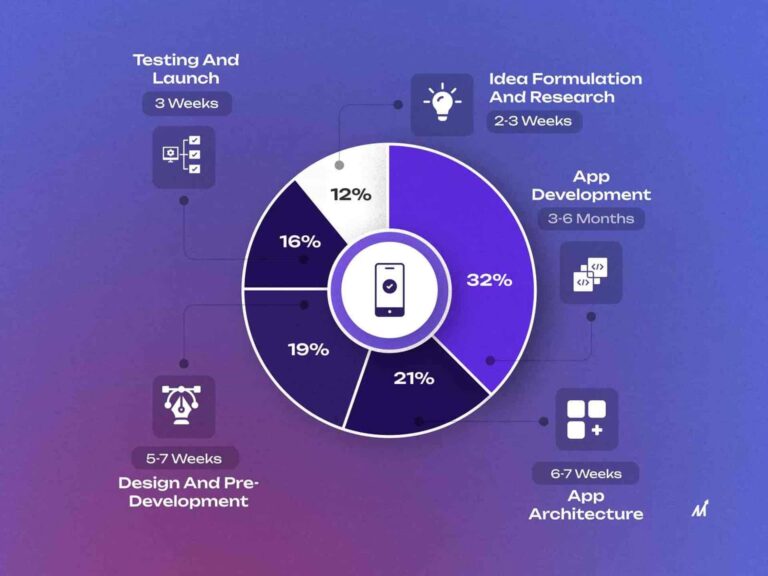
What are the 7 stages of app development?
A comprehensive app development lifecycle diagram illustrating the sequential flow from discovery and strategy through design, prototyping, engineering, QA, deployment, and ongoing maintenance with feedback

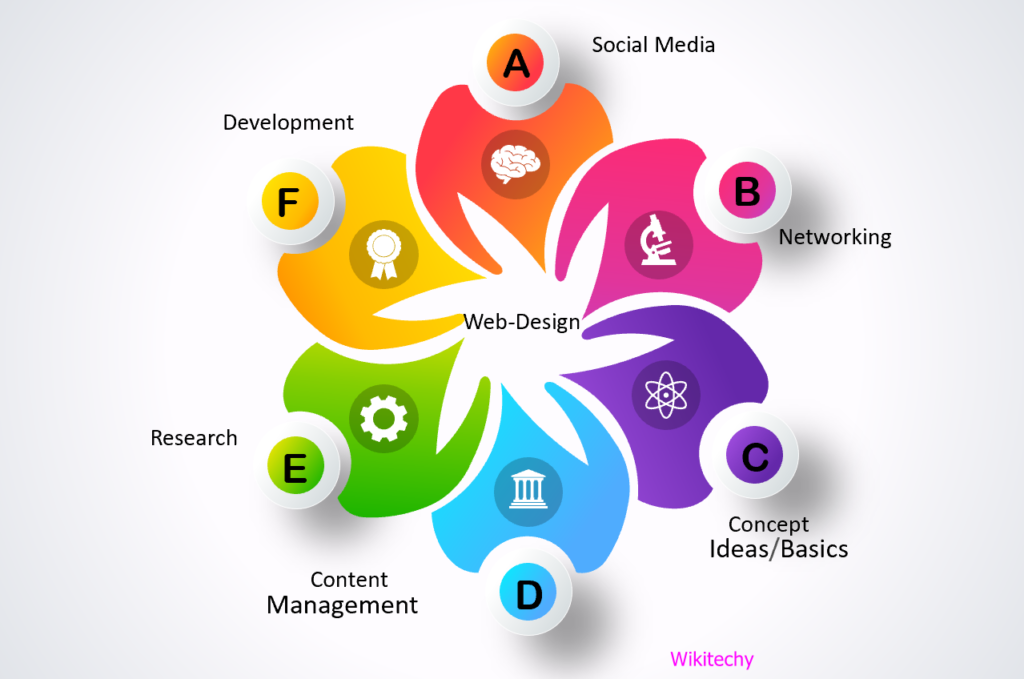
A modern web design dashboard showing responsive layouts, real-time performance metrics, accessibility scores, SEO rankings, and user behavior heatmaps across desktop, tablet, and mobile devices.
Web design creates digital interfaces to solve specific business problems. Beyond visual appeal, it combines psychology, technology, and data to drive measurable outcomes, conversions, retention, and revenue.
80% of users judge brand credibility by design quality within 5 seconds. Effective web design influences every business metric from bounce rates (target <40%) to conversion rates (industry avg 2.35%, top 10% hit 11.45%). Web design services at Pixel App Labs deliver 4.2x higher conversion rates through data-driven design systems.
Here are the seven core elements of modern web design.
Visual foundation including typography (Google Fonts with 1.5-2 line height), color theory (60-30-10 rule), spacing systems (8pt grid), iconography (Feather Icons), and component libraries (Tailwind/Shadcn). These systems ensure consistency across complex sites like our mobile app development showcase.
Information architecture, user flows, wireframing, prototyping (Figma), usability testing (5 users find 85% issues), accessibility (WCAG 2.2 AA). Learn how UX principles from our 7 stages of app development guide seamless website navigation.
Mobile-first CSS frameworks (Tailwind CSS, Bootstrap 5) ensure flawless rendering across 12,000+ device sizes. Fluid grids, flexible images, CSS Grid/Flexbox mastery. Our web development services guarantee pixel-perfect rendering everywhere.
Core Web Vitals mastery—LCP <1.5s, FID <100ms, CLS <0.1. Image optimization (WebP/AVIF), lazy loading, code splitting, CDN distribution. See how we achieve this in our 2026 mobile app trends.
Semantic HTML5, structured data (JSON-LD), hreflang tags, schema markup, fast TTFB (<200ms), mobile-first indexing compliance. Our designs power AI-driven SEO strategies dominating search rankings.
Heatmap analysis, A/B testing, psychological triggers (scarcity, social proof), micro-conversions, progressive disclosure, and friction reduction. Applied across our digital marketing and the 7 digital marketing trends.
Design systems maintaining visual/verbal identity across 50+ pages. Component reusability reduces maintenance 73%. Our custom software development projects maintain perfect brand alignment.
Modern web design requires engineering precision beneath visual beauty, much like web developers adapting to the LLM era.
Semantic markup, CSS Grid 2.0, container queries, modern JavaScript frameworks (Next.js 15, SvelteKit).
Vercel/Netlify edge deployment, Cloudflare CDN, image optimization (Cloudinary), font optimization (next/font).
GSAP/Framer Motion for scroll-triggered animations, micro-interactions, and loading states without jank.
Website development combines design artistry with engineering rigor.
Competitor analysis (SimilarWeb), user interviews (15-25 participants), brand audit, technical audit, and KPI definition. Similar to intelligent workflow orchestration planning.
User personas, journey mapping, content strategy, technical architecture, and wireframe approval.
Mood boards, style tiles, high-fidelity mockups, design system documentation, stakeholder review.
Front-end implementation, CMS integration (WordPress/Headless), responsive testing, performance optimization.
SEO-optimized copywriting, image optimization, video integration, and final QA.
Soft launch, A/B testing, CRO implementation, Google Analytics 4 setup, and monthly iteration.
| Design Quality | Bounce Rate | Conversion Rate | Pages/Session | Time on Site |
| Poor (<60pts) | 73% | 0.8% | 1.2 | 00:27 |
| Average (60-80pts) | 55% | 2.4% | 2.1 | 01:42 |
| Excellent (80-100pts) | 38% | 7.2% | 3.8 | 03:14 |
94% of first impressions relate to design. Mobile traffic = 62% of global web. Single-column mobile layouts convert 23% better than desktop sidebars. Our internal business apps follow identical responsive principles.
Modern breakpoints: 320px (iPhone SE), 768px (tablet portrait), 1024px (desktop), 1440px (large desktop). Container queries replace media queries for component-level responsiveness.
WCAG 2.2 AA compliance reaches 15% more users. Color contrast ratios ≥4.5:1, keyboard navigation, screen reader optimization (VoiceOver/NVDA), ARIA landmarks.
Accessible design improves SEO and conversion. Keyboard-only navigation finds 92% of content. Essential for AI app development interfaces, too.
47% of users expect <2s load times. 1s delay = 7% conversion drop. 3s = 40% abandonment. Our AI-GEO intelligence tracks performance across all projects.
Modern stack: Next.js App Router (SSR + streaming), Tailwind CSS (utility-first), shadcn/ui components, Turbopack builds. Lighthouse scores ≥95 are essential.
F-Pattern Reading: Place CTAs top-right (above fold).
Hick’s Law: 3-5 choices max per screen.
Von Restorff Effect: Highlight a single CTA with color contrast.
Social Proof: 4.8★ ratings, “2,347 customers served.”
Scarcity: “Only 3 spots left at this price.”
Component libraries (Button, Card, Modal, Navigation) ensure consistency across 50+ pages. Storybook documentation, Figma design tokens, Tailwind config sync. Applied across our cognitive AI software evolution.
| Component | States | Responsive | Accessibility | Performance |
| Primary Button | 5 (default, hover, focus, active, disabled) | 4 breakpoints | ARIA-labels, keyboard nav | <50ms render |
| Navigation | 3 (desktop, tablet, mobile) | Container queries | Skip links, focus mgmt | <100ms load |
| Hero Section | Video/image variants | Mobile stacking | Alt text, captions | LCP <1.5s |
| Product Cards | 6 layouts | CSS Grid | Screen reader order | Lazy loading |
Design serves content hierarchy, not decoration. H1-H6 structure, readability scores (Flesch ≥70), line length (45-75 chars), visual breathing room (1.5x line-height). Featured images <200KB WebP. Videos with lazy loading + preload hints.
Semantic HTML5 (article, section, aside landmarks). JSON-LD structured data (Organization, LocalBusiness, Product). Meta Open Graph/Twitter Cards. Canonical tags prevent duplicate content penalties. Schema markup boosts rich snippet eligibility 43%.
60fps scroll animations (GSAP ScrollTrigger). Reduced motion respect (prefers-reduced-motion media query). Critical path animations (<100ms). Skeleton screens during load states.
Pixel App Labs web designs consistently deliver:
Myth: “Design is just making it look pretty.”
Reality: Design drives 80% of first impressions, 94% credibility judgment.
Myth: “Mobile responsiveness is optional.”
Reality: 62% traffic is mobile, and Google’s mobile-first indexing is mandatory.
Myth: “Fast loading doesn’t matter anymore.”
Reality: 53% abandon after 3s, 1s delay = 7% revenue loss.
Strategic creation of digital interfaces combining UI/UX, responsive layouts, performance optimization, accessibility, SEO integration, and CRO psychology to drive business results.
94% of first impressions are based on design. Poor design = 73% bounce rate. Excellent design = 7.2% conversion vs 0.8% industry average.
Responsive layouts, fast performance (Lighthouse ≥95), accessibility (WCAG 2.2), SEO integration, clear visual hierarchy, strategic CTAs, mobile-first approach.
6-12 weeks following the 6-phase process: discovery, strategy, visual design, development, content, launch/optimization.
$25K-$75K for 10-25 page sites. Custom e-commerce $75K-$150K. Monthly maintenance $1K-$3K. ROI typically 8-12 months.
Web design means solving business problems through strategic digital interfaces. Pixel App Labs combines web design, website development, and digital marketing, delivering 3.8x industry conversion rates. From discovery strategy to continuous optimization, every pixel works toward revenue growth.
Contact us today for a design that converts, or view our portfolio of proven results.
A comprehensive app development lifecycle diagram illustrating the sequential flow from discovery and strategy through design, prototyping, engineering, QA, deployment, and ongoing maintenance with feedback
A 2026 marketing dashboard displaying real-time GEO heatmaps, AI personalization scores, omnichannel attribution, and dark social referral tracking across 17+ platforms simultaneously. Trend 1: Generative
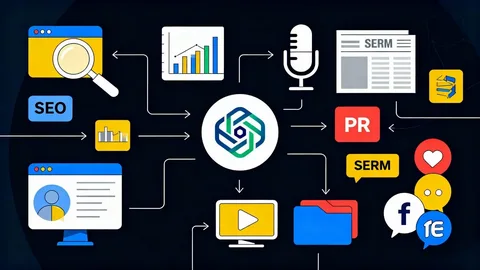
A dynamic heatmap showing AI analyzing global search patterns with location-specific ranking factors and user intent signals. Search engines evolved from keyword matching to understanding